



French e-invoicing: one month after 1 September 2026, where does your Magento store stand?
The French e-invoicing mandate has been in force for a month. What already applies to your Magento store depending on its size, what the DGFiP's start-up tolerance really covers, the launch figures, and what to check before the end of October, for B2B and B2C alike.
In this article
- Key takeaways
- What has been in force since 1 September, and for whom
- The DGFiP tolerance: what it covers, what it does not
- The launch figures
- B2B store: the 5 points to check this month
- B2C store: transaction e-reporting applies to you
- Selling into France from abroad?
- Back-to-school checklist
- In short
- Sources
Key takeaways
- The French e-invoicing mandate has been in force since 1 September 2026: every company subject to VAT and established in France must be able to receive electronic invoices; large enterprises and mid-caps must also issue invoices electronically and transmit their e-reporting. SMBs and micro-businesses follow on 1 September 2027.
- The DGFiP has announced a start-up tolerance for good-faith companies that regularise their situation: it is neither a postponement nor a suspension, and total inaction remains punishable.
- According to the ministerial press release of 11 July 2026, about 130 approved platforms are listed on the official register and 2 million companies have declared having one.
- A Magento store is concerned whatever its model: B2B through e-invoicing, B2C through transaction e-reporting, and in both cases through reception.
What has been in force since 1 September, and for whom
The mandate stems from article 91 of the 2024 Finance Act. It rests on three distinct obligations, detailed in our article on the 3 flows of the reform:
- e-invoicing: domestic B2B invoices between VAT-registered businesses go through an Approved Platform (Plateforme Agréée, PA);
- transaction e-reporting: B2C sales and transactions with VAT-registered businesses not established in France (export, intra-EU, etc.), transactions exempt under articles 261 to 261 E of the French General Tax Code (banking, insurance, healthcare, education, etc.) being excluded;
- payment e-reporting: payments received for services for which VAT becomes due on payment.
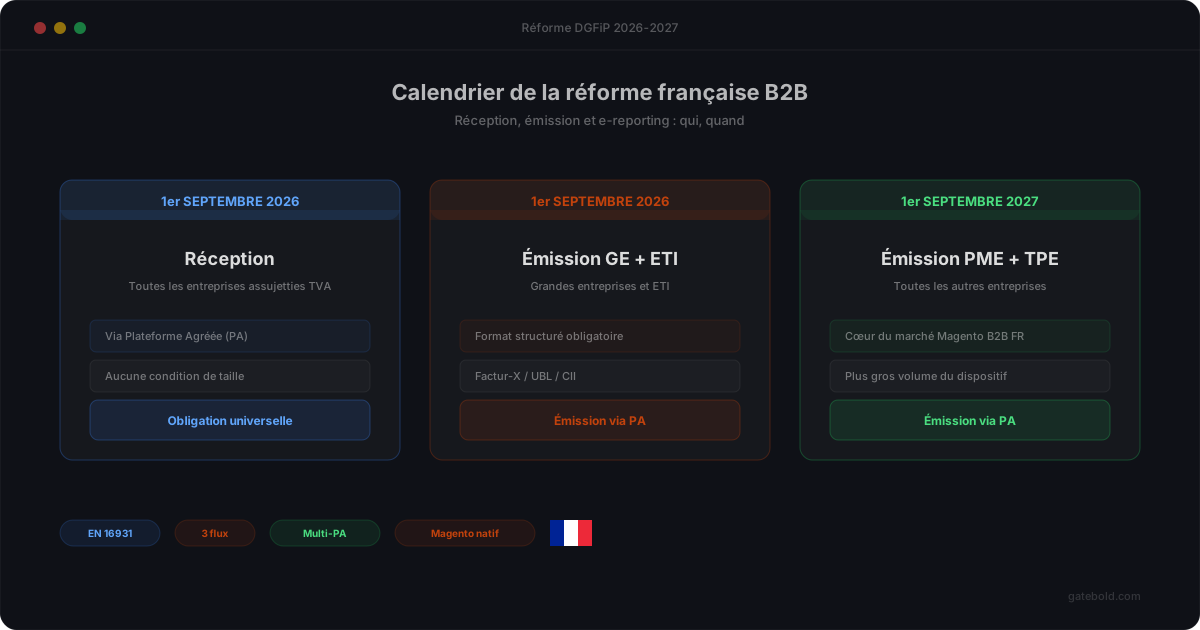
The timeline depends on company size, with one exception: reception, which has applied to everyone for a month.
| Company size | Invoice reception | B2B emission (e-invoicing) | E-reporting (transactions and payments) |
|---|---|---|---|
| Large enterprise | 1 September 2026 | 1 September 2026 | 1 September 2026 |
| Mid-cap (ETI) | 1 September 2026 | 1 September 2026 | 1 September 2026 |
| SMB | 1 September 2026 | 1 September 2027 | 1 September 2027 |
| Micro-business | 1 September 2026 | 1 September 2027 | 1 September 2027 |
One thing to keep in mind when reading this table: the public invoicing portal does not file anything. It acts as a directory and as a concentrator towards the administration; every company, whatever its size, goes through an Approved Platform to receive and issue invoices. The full timeline and data preparation are covered in our guide to the French mandate for Magento.
The DGFiP tolerance: what it covers, what it does not
On 10 July 2026, the DGFiP presented in Bercy a practical guide of 29 questions and answers on the launch of the reform, announced the following day. David Amiel, Minister for Public Action and Accounts, summed up the doctrine in the 11 July 2026 press release: “At the start of this reform, there will be no penalties for good-faith companies that encounter a difficulty and undertake the work needed to regularise their situation” (our translation).
What the tolerance covers. During the transition, an invoice sent by email, as a PDF or on paper remains valid under conditions: the transaction must be genuine and the mandatory mentions present. A documented technical incident (PA rejection, outage, format error, etc.) does not trigger a penalty if the company regularises. Proof of good faith is therefore concrete: a project under way, incidents logged, corrections made.
What it does not cover. The penalties set by law remain in place and target total inaction: EUR 50 per non-compliant invoice, capped at EUR 15,000 per year, and EUR 500 per missing e-reporting transmission, with the same annual cap. A large enterprise or mid-cap that keeps sending 100% of its B2B invoices as PDFs without having chosen a PA or started a connection is not in the situation the tolerance is meant for.
If you are stuck, the DGFiP has opened a dedicated helpline: 0806 807 807, Monday to Friday from 8:30 am to 6 pm (French time).
The launch figures
According to the ministerial press release of 11 July 2026, the official register listed about 130 approved platforms, and 2 million companies had declared having an approved platform. These figures predate 1 September, but they give two useful indications for a Magento merchant.
First, the PA offering is broad: the choice of platform is no longer a blocking factor, and a decoupled architecture lets you switch without touching the store. Second, a significant share of your business customers already have a PA and therefore expect your invoices through that channel. If your key accounts chased you in September about your invoices, this is the mechanism at play: a PDF by email has become an exception they have to handle manually.
B2B store: the 5 points to check this month
If you are a large enterprise or a mid-cap invoicing from Magento (Sales / Invoice), September was your first month under the obligation. Here is what to check before the end of October.
- Your PA connection actually works. Not just a signed contract: September invoices have been transmitted, and each one has a status returned by the PA (filed, rejected, accepted, etc.). An invoice without a status is an invoice you cannot tell has arrived.
- Your customers can be identified in the directory. A B2B invoice is routed to the recipient’s PA through its SIREN or SIRET. A Magento customer account without a SIRET, or with a wrong one, produces an invoice that cannot be delivered. Run a check on your active B2B accounts.
- Rejections are handled. A PA rejects an invoice for a specific reason (missing mention, inconsistent amount, format, etc.). The rejection must be visible, understood and corrected, then the invoice resubmitted. A rejection ignored for weeks is exactly the kind of situation the tolerance does not protect.
- Credit notes follow the same circuit. B2B credit notes are invoices in the sense of the mandate. Check that your Magento credit memos also go to the PA, with the reference of the original invoice.
- Reception is in place on the supplier side. Your purchase invoices now arrive through your PA: make sure your accounting picks them up, without relying on a PDF sent in parallel.
If you are an SMB, these five points are your work plan for the next twelve months.
B2C store: transaction e-reporting applies to you
A store that only sells to consumers issues no electronic B2B invoice, but it is not outside the mandate. Its sales fall under transaction e-reporting: amounts aggregated by day and VAT rate, transmitted by period, transmitted to the administration via a PA. B2B transactions with VAT-registered businesses not established in France (export, intra-EU, etc.) are transmitted invoice by invoice. If the store also sells services, the related payments additionally fall under payment e-reporting.
The frequency does not depend on your volume but on your VAT regime (art. 242 nonies O of Annex II to the French General Tax Code):
| VAT regime | Transmission frequency | Deadline |
|---|---|---|
| Monthly standard regime (réel normal mensuel) | Three transmissions a month (one per ten-day period) | Within 10 days of the end of the ten-day period |
| Quarterly standard regime (réel normal trimestriel) | Monthly | Within 10 days of the end of the month |
| Simplified regime (réel simplifié) | Monthly | Between the 25th and the 30th of the following month |
| VAT exemption scheme (franchise en base) | Every two months | Between the 25th and the 30th of the month following the two-month period |
In practice, a mid-cap under the monthly standard regime selling B2C from Magento should have transmitted its sales from 1 to 10 September before 20 September, those from 11 to 20 before 30 September, and so on. This is the point B2C merchants most often discover late: the obligation has existed for a month for large enterprises and mid-caps, and the fine provided for is EUR 500 per missing transmission. A B2C SMB has until 1 September 2027, but must already be able to receive its suppliers’ invoices.
Selling into France from abroad?
A foreign company without a permanent establishment in France is not subject to e-invoicing, but it is subject to e-reporting for its transactions taxable in France, via an approved platform, following the same timeline by company size. A Magento store operated from Belgium, Germany or Switzerland that sells to French consumers with French VAT is therefore concerned, since 1 September 2026 if it is a large enterprise or a mid-cap, and always through a PA registered with the DGFiP. One important exception: the DGFiP excludes from transaction e-reporting sales to consumers when the non-established operator declares that VAT through an EU one-stop shop (OSS or IOSS), which is the case for most European distance-selling stores.
Back-to-school checklist
- My size category is established (large enterprise, mid-cap, SMB, micro-business) and I know my deadline for emission and e-reporting.
- I have chosen an Approved Platform listed on the official register and I can receive electronic invoices.
- My B2B customer accounts in Magento have a verified SIRET and VAT number.
- My B2B invoices and credit notes go to my PA with a returned status, and rejections are handled.
- My VAT regime is identified and the frequency of my transaction e-reporting is known, with a first transmission completed or scheduled.
- My technical incidents are documented (date, invoices concerned, actions taken) and the team knows the DGFiP helpline number.
In short
One month after 1 September 2026, the mandate runs at two speeds: large enterprises and mid-caps are under the full obligation, SMBs are under the reception obligation with a year ahead of them for the rest. The tolerance announced by the DGFiP protects those who move forward and document their difficulties, not those who wait. For a Magento store, the work comes down to three questions: do my B2B invoices go through my PA, is my e-reporting transmitted at the right frequency, and does my customer data allow invoices to be routed?
Gatebold E-Invoice Gateway is a compatible e-invoicing solution for Magento 2 and Adobe Commerce, connected to registered Approved Platforms, covering the three obligations of the reform, whether you sell to businesses or to consumers: invoices and credit notes (e-invoicing), transaction e-reporting and payment e-reporting, from EUR 139 per month: see E-Invoice Gateway and our compatible solution status page.
Sources
Timeline, obligations, practical launch guide (July 2026), fact sheets and e-reporting frequency table: DGFiP, facturation électronique et plateformes agréées (in French). Links and figures checked on 27 September 2026.