



PA, OD, Compatible Solution: who does what in the French e-invoicing reform
Approved Platform, Dematerialization Operator, Compatible Solution: three distinct roles the market keeps confusing. What each one is allowed to do, what it cannot do, and how to combine them correctly.
In this article
Key takeaways
- The mandate is in force: reception has been mandatory for all companies since September 1st, 2026; emission and e-reporting since that date for large enterprises and mid-caps, from September 1st, 2027 for SMBs and micro-businesses.
- The reform structures the market around three roles: the Approved Platform (PA), the Dematerialization Operator (OD) and the Compatible Solution.
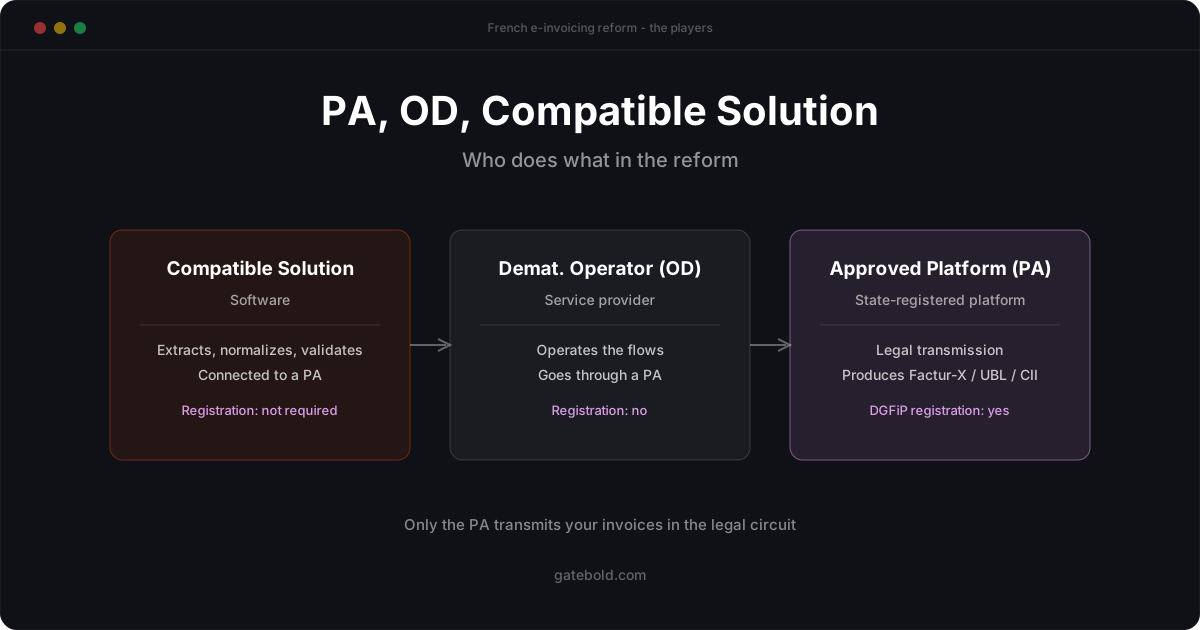
- Only the PA is registered with the DGFiP and authorized to transmit your invoices in the legal circuit.
- The OD operates dematerialization services but must go through a PA.
- The Compatible Solution is software connected to at least one registered PA - a functional status, identified by an official DGFiP logotype.
- For a company, only one brick is mandatory: the PA. The others are chosen according to your invoicing system and automation needs.
Why three roles, and why so much confusion
The French reform created a multi-layer ecosystem, and market vocabulary does not help: “platform”, “portal”, “operator”, “solution”, plus the old term PDP still alive in many sales decks. The result: vendors implying they are “approved” when they are not, and companies believing they comply while missing the mandatory link.
The reading grid is simple if you start from the legal question: who has the right to transmit an invoice in the legal circuit? Answer: only Approved Platforms, registered with the DGFiP. The rest of the ecosystem - ODs, Compatible Solutions, etc. - works around that regulatory monopoly.
The Approved Platform: the only registered player
The Approved Platform obtained its registration from the DGFiP after a demanding application (security, interoperability, financial guarantees, etc.). It alone can:
- transmit your B2B invoices to the recipient’s platform in the legal circuit;
- produce the regulatory format (Factur-X, UBL or CII) that is legally authoritative;
- feed the tax administration with invoicing and e-reporting data;
- manage the invoice’s regulatory lifecycle (deposited, rejected, paid statuses, etc.).
It is the mandatory link: every company subject to VAT must have chosen its PA. Reception has been mandatory for all companies since September 1st, 2026; emission and e-reporting have applied since that same date to large enterprises and mid-caps, and will apply to SMBs and micro-businesses from September 1st, 2027. The official list of registered PAs is published by the DGFiP; it is the only authoritative source.
Dematerialization Operator (OD): definition and role
The Dematerialization Operator (OD) is a provider operating services around the invoice: creation, enrichment, flow routing, archiving, etc. The decisive nuance: an OD is not registered. It can carry flows, prepare them, operate them on behalf of clients - but when entering the legal circuit, its flows must pass through an Approved Platform.
An OD is useful when a company wants to outsource the operation of its invoicing flows, particularly in complex multi-system environments (several ERPs, several entities, heterogeneous formats, etc.). The caution point: some ODs communicate ambiguously about their status. An OD presenting itself as a “dematerialization platform” without stating it is not registered maintains a confusion that can cost its client dearly.
The Compatible Solution: software qualified by its features
The Compatible Solution is a different category from the previous two: it is not an operator, it is software. Accounting, business or invoicing software is “compatible” when it meets two conditions defined by the DGFiP:
- being compatible with the formats and requirements of the reform for the features it offers (issuing, receiving, or transmitting transaction and payment data);
- being connected to at least one registered Approved Platform.
The DGFiP created an official “Solution compatible facturation électronique” logotype so companies can identify such software. Its use is governed by a charter: it attests to compatibility and an effective connection to a PA, nothing more - it is neither an approval nor a certification, two notions that do not exist for software.
Concretely, a Compatible Solution works upstream of the PA: it extracts invoices from your system (a Magento store, for example), normalizes and validates the data, then transmits them to your PA which takes over the regulatory part. For a detailed comparison of these two links applied to a Magento store, see Approved Platform vs Compatible Solution: what difference for your Magento.
The summary table
| Approved Platform | Dematerialization Operator | Compatible Solution | |
|---|---|---|---|
| Nature | Registered platform | Service provider | Software |
| DGFiP registration | Yes, mandatory | No | No (not applicable) |
| Legal invoice transmission | Yes, exclusive | No - through a PA | No - through a PA |
| Regulatory format production | Yes | Possible as preparation, no legal value | No - transmits compliant data to the PA |
| Official DGFiP logotype | “Plateforme agréée” logotype | None | “Solution compatible” logotype |
| Mandatory for the company | Yes | No | No |
How to combine them, depending on your situation
- You invoice from an accounting ERP that is itself connected to a PA (or operated by the same company as a PA): your chain is short - ERP → PA. Just verify that all your invoices actually flow through the ERP.
- You invoice from a business system (a Magento store, an industry-specific management tool, etc.): a Compatible Solution bridges that system and your PA - chain: business system → Compatible Solution → PA.
- You have a complex multi-entity or multi-system environment: an OD can operate the consolidation of flows, relying on one or several PAs downstream.
In every case, the verification reflex is the same: identify which registered PA ends the chain, and check it on the official list. If a vendor cannot answer that question clearly, that is a red flag.