



French e-invoicing 2026-2027: the complete guide for Magento merchants
Timeline, actors, formats, and a concrete action plan to bring your Magento or Adobe Commerce store into compliance with the French B2B e-invoicing reform.
In this article
- Key takeaways
- What is electronic invoicing under the French reform?
- The French e-invoicing mandate: who, what, when
- The 3 flows the reform imposes
- The actors of the new framework
- Magento in the reform: 4 typical scenarios
- The standardized formats: Factur-X, UBL, CII
- Preparing your Magento store: 6 concrete steps
- Official sources to go further
- Summary
- Going further
Key takeaways
- The mandate is in force: since September 1st, 2026, reception is mandatory for all companies and emission for large enterprises and mid-caps; on September 1st, 2027, emission becomes mandatory for SMBs and micro-businesses.
- Three obligations to cover: B2B e-invoicing, transaction e-reporting (B2C, export, intra-EU, etc.), payment e-reporting.
- The mandatory channel is the Approved Platform (Plateforme Agréée) (PA), an entity registered with the DGFiP - several are available on the French market.
- For a Magento store, compliance goes either through an accounting ERP that interfaces with your PA, or through a Compatible Solution on the Magento side that bridges to your PA.
What is electronic invoicing under the French reform?
Electronic invoicing is a framework requiring VAT-registered companies in France to transmit their B2B invoices in structured format, through a platform approved by the Direction Générale des Finances Publiques. Tax data is thus reported to the administration in near real time, and exchanges between suppliers and buyers become interoperable without manual data entry.
Concretely, this means you can no longer send a simple PDF invoice by email to your French business customer. The invoice must be generated in a standardized format, transmitted to your Approved Platform, which then relays it to your customer’s PA and feeds the DGFiP central directory.
The French e-invoicing mandate: who, what, when
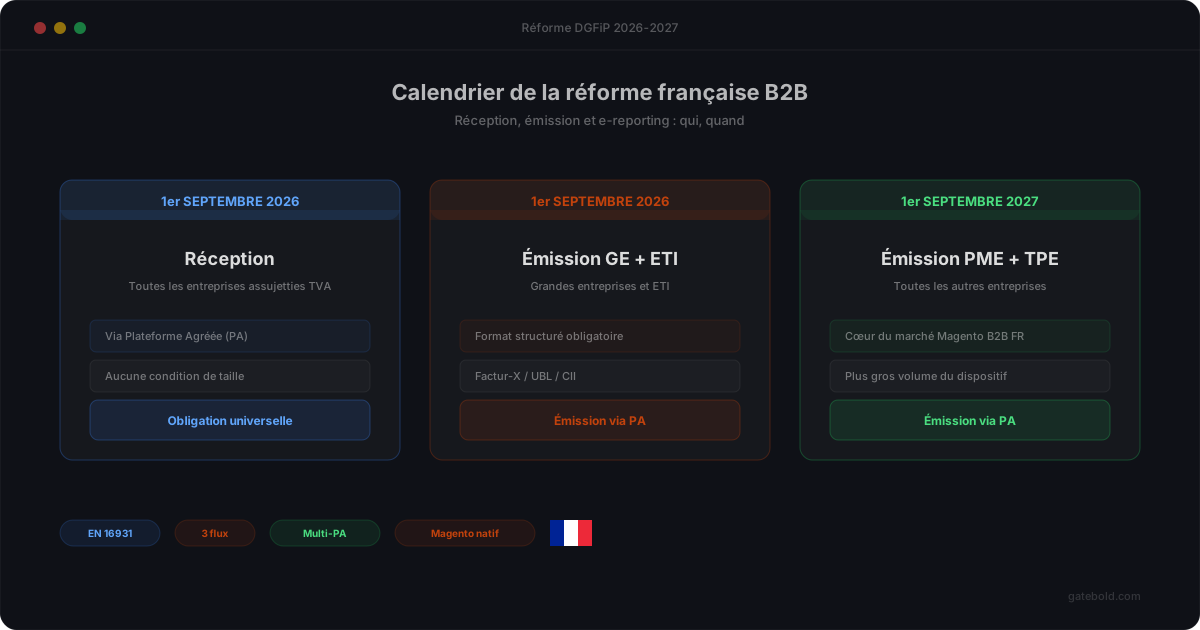
The mandate came into force on September 1st, 2026 and applies in two stages, depending on company size. Every VAT-registered company in France is concerned; what changes with size is when the emission and e-reporting obligations kick in. Here is the official timeline:
| Date | Obligation | Scope concerned |
|---|---|---|
| September 1st, 2026 (in force) | Reception through an Approved Platform | All VAT-registered companies, regardless of size |
| September 1st, 2026 (in force) | Emission in structured format and e-reporting | Large enterprises (GE) and mid-caps (ETI) |
| September 1st, 2027 (next deadline) | Emission in structured format and e-reporting | SMBs and micro-businesses (PME/TPE) |
For the vast majority of French Magento B2B merchants, who are SMBs, the critical deadline for emission is therefore September 1st, 2027. But reception has been mandatory since September 1st, 2026: you must already have an active Approved Platform channel, even if you are not yet emitting in structured format. If you are a large enterprise or a mid-cap, emission and e-reporting have applied to you since that same date.
The 3 flows the reform imposes
The reform does not cover a single flow. It organizes three distinct obligations that every company in scope must be able to address.
| Flow | Purpose | When is it triggered? |
|---|---|---|
| E-invoicing | Transmission of the B2B invoice to the recipient via the PA | For every invoice issued to a French business customer |
| Transaction e-reporting | Declaration of B2C, export, intra-EU sales, etc. (operations not covered by e-invoicing) | Depending on your VAT regime: from three transmissions a month (monthly standard regime) to one every two months (VAT exemption scheme) |
| Payment e-reporting | Payments received for services (VAT due on payment) | At the same frequency as transaction e-reporting |
For a typical Magento B2B merchant, all three flows are generally relevant: you issue invoices to business customers (e-invoicing), you also sell to consumers or export (transaction e-reporting), and if you sell services, the payments you receive for them must be declared (payment e-reporting). A compliant connector must cover all three.
The actors of the new framework
The reform’s architecture relies on four distinct roles. Understanding who does what is essential to choose your setup.
The DGFiP defines the rules, registers the Approved Platforms, maintains the central directory of companies, and receives tax data. It does not receive each company’s invoices directly: the Portail Public de Facturation (PPF), announced in 2021 as a free invoice-filing platform, was refocused in October 2024 on two functions only, the central directory and the concentrator of the data transmitted by the PAs. It offers no invoice-filing service.
The Approved Platform (PA) is the operator registered with the DGFiP. It receives the invoice issued by your company, validates it structurally, transmits it to the recipient’s PA, feeds the central directory, and reports aggregated tax data. It is the equivalent of a licensed telecom operator, but for invoicing. You freely choose your PA on the French market.
The central directory is the service maintained by the DGFiP that lets each PA know how to reach a recipient’s PA. It guarantees that the invoice finds its recipient regardless of the PAs chosen by each party.
Your Compatible Solution is the component that bridges your stack (Magento, ERP, etc.) and your Approved Platform. It is not registered with the DGFiP but must produce compliant invoices (standardized formats, mandatory data, etc.) and know how to talk to your PA. This is typically the role of a dedicated Magento connector. To go deeper on this distinction, see Approved Platform vs Compatible Solution: who does what.
Magento in the reform: 4 typical scenarios
Not all Magento stores are in the same situation. Here are the four most frequent configurations, with their implications.
Case 1: Magento store with an accounting ERP that issues the legal invoices. If your ERP (Sage, Cegid, Odoo, etc.) generates and stores your official invoices, that ERP is what must interface with your Approved Platform. Magento then plays an upstream commercial role with no direct involvement in electronic invoicing. You work with your ERP vendor to activate its PA connector.
Case 2: Magento store without an ERP, invoicing from Magento Sales / Invoice. This is the typical case of many French B2B merchants who issue their invoices directly from the Magento Sales interface. In this configuration, your Magento is what must provide conformant invoice data and transmit it to the PA. A dedicated Magento Compatible Solution becomes necessary: it extracts the invoice issued by Magento, normalizes its data against the EN 16931 model, validates it, and transmits it to your PA, which produces the regulatory format.
Case 3: Magento store with a custom invoicing module. If you have a custom Magento module that issues your B2B invoices with specific business rules, you must check that this module produces all the mandatory data of the reform (buyer SIRET, detailed legal mentions, VAT by rate, etc.). Otherwise, you will have to evolve it in parallel with the reform compliance work.
Case 4: Multi-channel store (Magento + marketplace + point of sale). If your sales channels are multiple, each flow must be tracked. The Magento B2B flow goes through your PA (e-invoicing), marketplace sales go through the marketplace’s obligations, and the point of sale feeds transaction e-reporting. A centralized approach through a single operator simplifies the follow-up.
The standardized formats: Factur-X, UBL, CII
The reform accepts three formats for the structured electronic invoice, all compliant with the European norm EN 16931. Here is their positioning.
| Format | Nature | When to use it |
|---|---|---|
| Factur-X | Hybrid PDF/A-3 with embedded CII XML (Franco-German origin, 2017) | Recommended transition format: human-readable, machine-parsable |
| UBL 2.1 | Pure XML, OASIS standard from 2013, foundation of the European PEPPOL network | Fully automated flows, mature EDI integration |
| UN/CEFACT CII | XML, the UN’s Cross Industry Invoice schema | International flows and cases where your PA explicitly recommends CII |
In practice for a Magento B2B merchant, Factur-X is most often the recommended starting format: it satisfies both those who want structured data (DGFiP, recipient ERPs) and those who want to see a PDF (the customer’s accountant opening the invoice to read it). UBL becomes preferable when your customers are on PEPPOL or when you need high throughput without a visual rendering.
A good Compatible Solution guarantees normalized, validated and traceable EN 16931 data all the way to the PA; it is then the PA that produces the regulatory format (Factur-X, UBL or CII) according to your recipient’s preferences. For the technical details of each format and their use cases, see Factur-X, UBL, CII: which format to choose.
Preparing your Magento store: 6 concrete steps
Here is a six-step action plan to go from “nothing done” to “compliant” without rushing. If you are an SMB or a micro-business, the September 1st, 2027 emission deadline still leaves time to run through these steps; if you are a large enterprise or a mid-cap, they need to be handled without delay.
- Identify your scenario. Go back to the four scenarios above and determine yours. This analysis determines whether you need to activate an ERP connector or install a Compatible Solution on the Magento side.
- Choose your Approved Platform. Consult the official list of PAs registered with the DGFiP. Compare the criteria that matter to you: pricing, geographic availability, support quality, integration with your stack, technical guidance, etc.
- Check the completeness of your invoicing data. Do your Magento invoices contain all the mandatory data of the EN 16931 norm? Buyer SIRET, VAT identifiers, legal mentions per product, VAT by rate, etc. An upfront audit avoids mass rejections at launch.
- Set up invoice normalization. Install the connector or Compatible Solution that extracts your Magento invoices, normalizes their data against the EN 16931 model, validates it, and transmits it to your PA (which produces the regulatory format). This component must also handle transaction and payment e-reporting.
- Test in sandbox. All PAs provide a test environment. Send a representative volume of your invoices (B2B, B2C, export, credit notes, etc.) and check that the returned statuses are clean. Fix any business data anomalies detected.
- Move to production progressively. If possible, start with a subset of customers (for instance those already asking for electronic invoices) before generalizing. Monitor the first emission, reception and e-reporting cycles for a month.
This plan generally takes 8 to 13 weeks for a well-equipped Magento store. For stores with scattered business data or custom modules, allow more time to absorb the data audit. The detailed phase-by-phase rollout is in the article Magento and e-invoicing: how to get compliant.
Official sources to go further
Any decision regarding reform compliance must rely on official sources. Here are the references to consult and share with your accountant.
- DGFiP website - Electronic invoicing and Approved Platforms: impots.gouv.fr/facturation-electronique-et-plateformes-agreees. Official timeline, list of registered PAs, administration FAQ (in French).
- European norm EN 16931: reference norm for electronic invoicing in Europe, available via AFNOR.
- Factur-X standard: maintained by FNFE-MPE (France) and FeRD (Germany, under the name ZUGFeRD).
- UBL 2.1 specifications: published by OASIS, technical foundation of the PEPPOL network.
- PEPPOL: interoperable European network for exchanging B2G and B2B electronic invoices, useful for cross-border EU flows.
Summary
The French e-invoicing reform requires all VAT-registered companies to move their B2B invoicing to a structured format, transmitted through an Approved Platform. The timeline is being applied: since September 1st, 2026, universal reception and emission by large enterprises and mid-caps; on September 1st, 2027, emission by SMBs and micro-businesses. The accepted formats are Factur-X, UBL and CII, all compliant with the European norm EN 16931.
For a Magento B2B merchant, the challenge is to identify your scenario, choose your Approved Platform, then activate the right connector on the Magento side - either through your accounting ERP, or through a dedicated Compatible Solution. Starting without delay and testing in sandbox are the two keys to absorbing data adjustments before your emission deadline.
Going further
Each facet of the reform has a dedicated article in the E-Invoice cluster:
- Approved Platform vs Compatible Solution: who does what in the DGFiP framework - understand the division of roles between your PA and your Magento connector.
- Factur-X, UBL, CII: which electronic invoice format to choose - technical comparison and recommendation for a Magento B2B merchant.
- EN 16931: the semantic model of the electronic invoice - the European standard that defines the mandatory data behind the three formats.
- E-invoicing, transaction e-reporting, payment e-reporting: the 3 obligations of the mandate - which ones concern you depending on your activity, and at what frequency.
- Lifecycle of an electronic invoice: the 7 steps on the Magento side - returned statuses, rejection handling and manual replay.
- Magento compliance action plan - concrete 6-phase rollout to prepare your store.
To discuss your specific case, the Gatebold E-Invoice Gateway product opens a technical discussion with no commitment. For the plan details, see our E-Invoice pricing.