



E-invoicing, transaction e-reporting, payment e-reporting: the 3 flows of the DGFiP reform
The French e-invoicing reform does not impose a single flow but three distinct obligations. Understand which ones apply to you, when they are triggered, and how they fit together for your Magento 2 or Adobe Commerce store.
In this article
- Key takeaways
- Why three flows and not just one?
- Flow #1: e-invoicing
- Flow #2: transaction e-reporting
- Flow #3: payment e-reporting
- Comparison table of the 3 flows
- Which flows for which Magento case
- E-reporting: which frequency for your VAT regime?
- 100% B2C store: what do you have to transmit?
- Common mistakes about the 3 flows
- Summary
- Going further
Key takeaways
- The mandate is in force: reception has been mandatory for all companies since September 1st, 2026; emission and e-reporting have applied since that date to large enterprises and mid-caps, and will apply to SMBs and micro-businesses from September 1st, 2027.
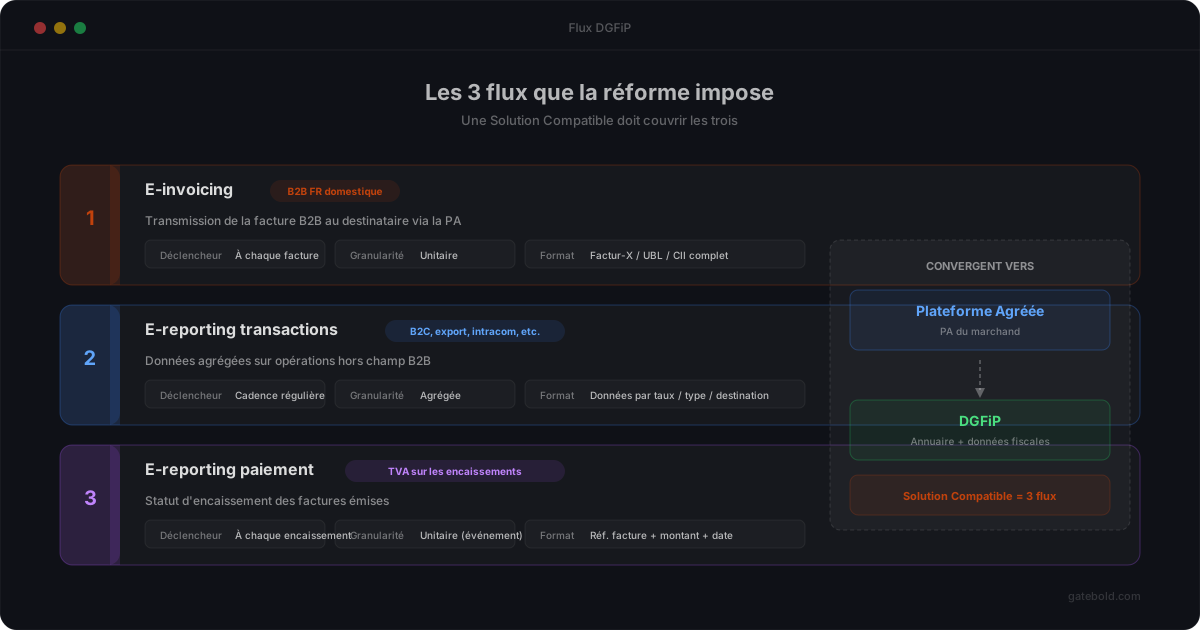
- The French e-invoicing reform does not impose a single flow but three distinct obligations: e-invoicing, transaction e-reporting and payment e-reporting.
- E-invoicing: transmission of the French domestic B2B invoice to your client via an Approved Platform (Plateforme Agréée).
- Transaction e-reporting: declaration of B2C, export, intra-EU sales, etc. to the administration via the PA, at a frequency that depends on your VAT regime.
- Payment e-reporting: declaration of payments received for services, for which VAT becomes due on payment.
- For most merchants on Magento 2 or Adobe Commerce with a mixed B2B activity, the 3 flows apply in parallel: your Compatible Solution must be able to cover all three.
Why three flows and not just one?
The question comes up often: if the reform aims to give the administration near real-time visibility on VAT, why split into three flows rather than a single channel?
The answer lies in the nature of the operations. A domestic B2B invoice follows a clear circuit between an identified emitter and recipient, both French: the right channel is e-invoicing, which transmits the invoice itself via an Approved Platform. A B2C sale or an export sale has no business recipient in the French PA circuit: the administration does not need the detailed invoice, it needs aggregated data (B2C) or an invoice-by-invoice transmission (international B2B) - that is transaction e-reporting. Finally, the moment of payment is legally significant for services, whose VAT becomes due on payment: payment e-reporting reports that information.
The three flows therefore cover different objects (B2B invoice, B2C or international transaction, payment received for a service) with adapted mechanics. For you, as a Magento merchant, the challenge is to understand which ones apply to you and to cover them all through a unified Compatible Solution.
Flow #1: e-invoicing
Object. Transmission of a French B2B invoice to the recipient, via your Approved Platform, which routes it to the recipient’s PA. The administration receives the aggregated tax data in parallel.
When it is triggered. At each invoice emitted to a French business client. One B2B sale produces one e-invoicing transmission. No aggregated cadence: it is one event per invoice.
What data. The complete invoice data, normalized against the European EN 16931 semantic model, which your Approved Platform then turns into one of the three standardized formats (Factur-X, UBL 2.1 or UN/CEFACT CII). All B2B legal mentions are mandatory: buyer SIRET, VAT identifiers, per-line mentions, VAT per rate, etc.
Concrete Magento case. You sell 50 B2B orders on September 7th, 2026 to French business clients. Your Magento connector extracts the 50 invoices emitted from Sales / Invoice, normalizes their data against the EN 16931 model, and transmits them one by one to your PA (which produces the Factur-X). Each invoice gets an individual status (transmitted, accepted, rejected for reason X, etc.).
Scope. French domestic B2B only. B2C, export or intra-EU sales do not go through e-invoicing.
Flow #2: transaction e-reporting
Object. Declaration of the operations not covered by e-invoicing: B2C sales, exports outside the EU, intra-EU sales to individuals, international services, etc. The goal is to give the administration a company’s total VAT base, not just the domestic B2B share.
When it is triggered. At a frequency set by your VAT regime, not by your volume: three transmissions a month under the monthly standard regime, one a month under the quarterly standard regime or the simplified regime, one every two months under the VAT exemption scheme (see the table below). Transaction e-reporting is not triggered at each sale: it consolidates a period.
What data. For B2C sales: amounts aggregated by period and by VAT rate, not the complete invoice. For international B2B operations (intra-EU, export): an invoice-by-invoice transmission, with the invoice data. The format is defined by the DGFiP and carried by your Approved Platform.
Concrete Magento case. In September 2026 you processed: 800 B2C orders from French individuals (20% VAT), 30 export orders to Switzerland, 15 intra-EU B2B sales to German clients. Your connector aggregates the 800 B2C sales by VAT rate, transmits the 45 international operations invoice by invoice, and pushes everything as transaction e-reporting to your PA at your frequency. The administration receives the corresponding VAT data.
Scope. All operations subject to VAT that do not go through domestic B2B e-invoicing.
Flow #3: payment e-reporting
Object. Declaration of the payment collection statuses of emitted invoices. Lets the administration know not only the invoices emitted (via e-invoicing) but also when they are paid.
When it is triggered. On payments received for services, for which VAT becomes due on payment (TVA exigible à l’encaissement). For deliveries of goods, whose VAT becomes due on delivery, payment e-reporting is not required. Payment data is transmitted at the same frequency as transaction e-reporting.
What data. Reference of the invoice concerned, amount collected, collection date, possibly payment method. Not the complete invoice: a short structured event.
Concrete Magento case. You are a mid-cap, subject to emission and e-reporting since September 1st, 2026. You emit a B2B service invoice on October 15th, 2026 (sent via e-invoicing). Your client pays 30 days later, on November 15th. Your Magento connector detects the payment (payment recorded in Sales / Invoice, or accounting flow), builds the payment e-reporting data and transmits it to your PA with the next periodic transmission. The administration then knows the VAT on that invoice has become due.
Scope. Services only. If you only sell goods, payment e-reporting does not concern you in practice; if you also sell services, it applies to the payments received for them.
Comparison table of the 3 flows
| Criterion | E-invoicing | Transaction e-reporting | Payment e-reporting |
|---|---|---|---|
| Object | French B2B invoice transmitted to the recipient | Data on B2C, export, intra-EU sales, etc. | Payment received for a service |
| Scope | French domestic B2B only | B2C, export, intra-EU, etc. | Services (VAT due on payment) |
| Trigger | At each emitted invoice | Periodic, depending on your VAT regime | Periodic, same frequency as transactions |
| Granularity | Unitary (1 transmission per invoice) | B2C aggregated by period and VAT rate; international B2B invoice by invoice | One payment per service invoice |
| Content transmitted | Complete invoice in standardized format | Aggregated amounts (B2C) or invoice data (international B2B) | Invoice reference + amount + date |
| Format | Factur-X, UBL or CII | Format defined by the DGFiP via the PA | Format defined by the DGFiP via the PA |
| Data recipient | The B2B client + the administration | The administration only | The administration only |
| Channel | Approved Platform | Approved Platform | Approved Platform |
Which flows for which Magento case
To quickly clarify which flows apply to your store, here is a map of the most frequent situations.
100% French B2B Magento store. E-invoicing yes (all your clients). Transaction e-reporting no (no B2C or international sales). Payment e-reporting depending on what you sell (yes if you sell services, no for goods only). The simplest configuration.
100% French B2C Magento store. E-invoicing no (no B2B). Transaction e-reporting yes (all your sales fall into it). Payment e-reporting depending on what you sell. You are concerned by 1 to 2 obligations out of 3 - details in the dedicated section below.
Mixed French B2B + B2C Magento store. E-invoicing yes (for the B2B share). Transaction e-reporting yes (for the B2C share). Payment e-reporting depending on what you sell. The most frequent case in French B2B e-commerce: all 3 flows must be covered.
French B2B Magento store + intra-EU sales + export. E-invoicing yes (French B2B). Transaction e-reporting yes (intra-EU and export, invoice by invoice). Payment e-reporting depending on what you sell. You are typically concerned by all 3 flows with significant volume on transaction e-reporting.
French B2B services Magento store. VAT due on payment. E-invoicing yes. Transaction e-reporting no if everything is French B2B. Payment e-reporting yes, mandatory, for every payment received for a service.
E-reporting: which frequency for your VAT regime?
The frequency of e-reporting is not set by your sales volume but by your VAT regime (art. 242 nonies O of Annex II to the French General Tax Code). It applies to transaction e-reporting and payment e-reporting alike. Here is the table as published by the DGFiP:
| VAT regime | Transmission frequency | Deadline |
|---|---|---|
| Standard regime, monthly returns (réel normal mensuel) | Three transmissions a month (one per ten-day period) | Within 10 days after the end of the ten-day period |
| Standard regime, quarterly returns (réel normal trimestriel) | Monthly | Within 10 days after the end of the month |
| Simplified regime (réel simplifié) | Monthly | Between the 25th and the 30th of the following month |
| VAT exemption scheme (franchise en base) | Every two months | Between the 25th and the 30th of the month following the two-month period |
Source: DGFiP, Facturation électronique et plateformes agréées (e-reporting section, in French). Concretely, a Magento store under the monthly standard regime must prepare a transmission every ten days: it is your Compatible Solution that has to slice the periods, aggregate B2C sales by VAT rate and push everything to your PA on time, with no manual intervention.
100% B2C store: what do you have to transmit?
A Magento store that only sells to consumers issues no B2B electronic invoice: e-invoicing does not concern it. It does not escape the mandate, though. Since September 1st, 2026 for large enterprises and mid-caps, and from September 1st, 2027 for SMBs and micro-businesses, all of its sales fall under transaction e-reporting: amounts aggregated by period and by VAT rate (20%, 10%, 5.5%, etc.), transmitted to the administration through its Approved Platform at the frequency of its VAT regime. No invoice to transmit, no customer details: a structured summary of the period’s sales.
If that store also sells services to consumers (installation, subscription, training, etc.), the payments it receives for them additionally fall under payment e-reporting, since VAT on services becomes due on payment. A 100% B2C store selling goods only is therefore concerned by a single obligation; a B2C services store by two.
In both cases, the source data lives in Magento (orders, VAT breakdown, payments) and the job is to aggregate it correctly, period by period, then transmit it to the PA. That is what Gatebold E-Invoice Gateway handles for Magento 2 and Adobe Commerce, including for a store with no business customer at all.
Common mistakes about the 3 flows
Confusing e-invoicing and e-reporting. E-invoicing transmits a complete invoice to an identified recipient. E-reporting transmits aggregated or event-based data to the administration only. They are not two variants of the same flow.
Thinking e-reporting only concerns large players. Wrong. A Magento merchant with a few B2C sales or a few exports per month is concerned by transaction e-reporting, regardless of overall volume. The frequency depends on the VAT regime, not on volume; the obligation remains.
Choosing a Compatible Solution that covers only one flow. A classic mistake: picking a connector that handles e-invoicing but cannot feed e-reporting. You discover the gap 6 months later, under full regulatory pressure. Systematically check the coverage of the 3 flows before signing.
Ignoring payment e-reporting because you only sell goods. True as long as you only sell goods. But if you also sell services (installation, maintenance, subscription, etc.), the payments received for them trigger payment e-reporting. Check the nature of your sales line by line.
Believing your accountant handles everything for you. Your accountant can advise you but cannot generate the automated flows in your place. The 3 flows come out of your technical stack (Magento + Compatible Solution) to your PA. The accountant checks, they do not produce.
Summary
The 3 flows of the DGFiP reform cover distinct obligations: e-invoicing for the French B2B invoice transmitted to the recipient, transaction e-reporting for B2C, export and intra-EU sales, payment e-reporting for payments received for services.
Most Magento merchants with a mixed B2B activity are concerned by all three in parallel. A well-designed Compatible Solution covers the 3 flows from a single connector, avoiding scattered data and guaranteeing nothing is forgotten.
Going further
- The complete guide to the French DGFiP 2026-2027 reform for the overall context and timeline.
- Approved Platform vs Compatible Solution: who does what - the split of roles in the DGFiP scheme.
- Factur-X, UBL, CII: which format to choose - the standardized formats for each flow.
- EN 16931: the semantic model of the electronic invoice - the standard that defines the data carried by the e-invoicing flow.
- Lifecycle of an electronic invoice - what happens after e-invoicing emission.
- Magento compliance action plan - 6 phases to cover the 3 flows in your Magento.
To discuss the coverage of the 3 flows in your case, the Gatebold E-Invoice Gateway product opens a no-commitment technical discussion.