



French 2026 reform: which options for your Magento B2B store?
Accounting ERP interfaced with an Approved Platform, custom bridge, or Compatible Solution: the three ways to bring a Magento store into compliance with the French e-invoicing reform, their real costs and how to choose.
In this article
- Key takeaways
- The context in two sentences
- Option 1 - invoice from an accounting ERP interfaced with your PA
- Option 2 - build a custom bridge between Magento and your PA
- Option 3 - use a Compatible Solution
- The summary table
- How to choose: the decisions in order
- What about B2C and export sales?
- Where to start
Key takeaways
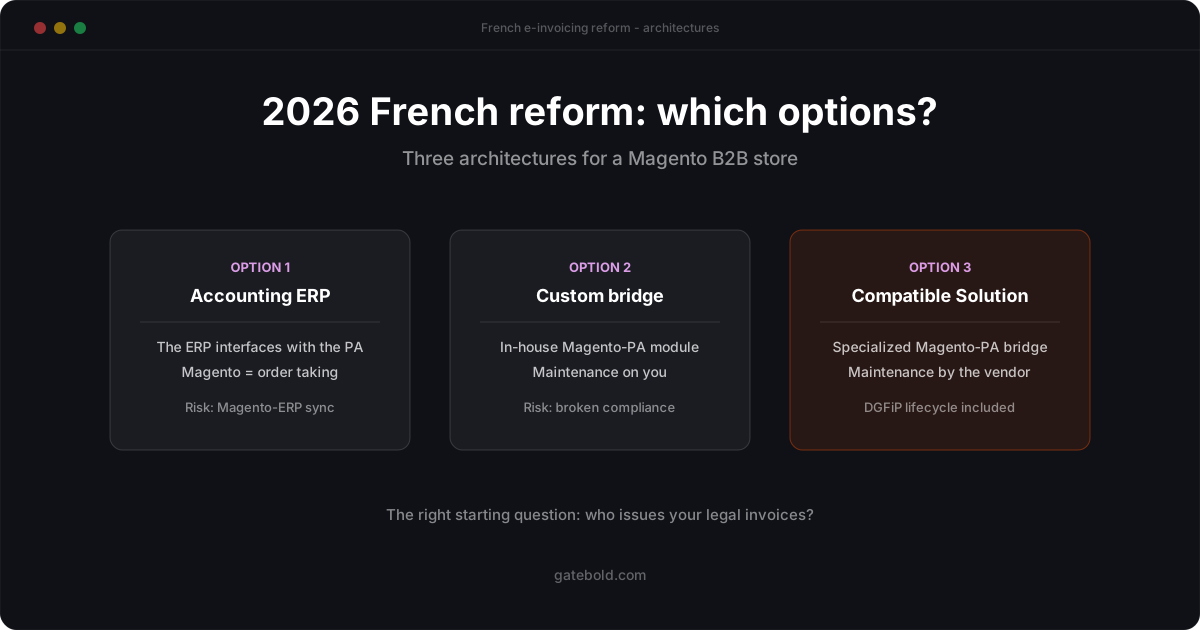
- A Magento B2B store has exactly three ways to comply with the French reform: invoice from an accounting ERP interfaced with an Approved Platform, build a custom bridge between Magento and a PA, or use a Compatible Solution.
- The right choice depends on one starting question: who issues your legal invoices - Magento or an ERP?
- The mandate is in force: reception has been mandatory for all companies since September 1st, 2026, emission and e-reporting since that date for large companies and mid-caps, from September 1st, 2027 for SMEs and micro-enterprises.
- The most underestimated criterion is not the initial cost but regulatory maintenance over time: the specifications will keep evolving after 2027.
- The detailed timeline by company size is covered in our complete reform guide for Magento - this article focuses on choosing the architecture.
The context in two sentences
Since September 1st, 2026, every company receives its invoices through an Approved Platform (Plateforme Agréée, PA), and every French domestic B2B invoice issued by a large company or a mid-cap - by an SME or a micro-enterprise from September 1st, 2027 - must transit through that PA, which produces the regulatory format and feeds the tax administration: the emailed PDF no longer counts as an invoice. Magento cannot do this natively: you must decide how your store fits into the new circuit. For the detailed calendar, the obligations by company size and data preparation, read the complete guide; here, we compare the three possible architectures.
Option 1 - invoice from an accounting ERP interfaced with your PA
The principle. Your legal invoices are issued and stored in an ERP or accounting SaaS (Sage, Cegid, Pennylane, Quadra, DBFact, etc.). Then the ERP interfaces with your Approved Platform; Magento remains an order-taking channel.
For whom. Merchants who already use an accounting ERP as the invoicing system of record, with a working Magento → ERP order synchronization.
The advantages. Your compliance project happens on the ERP side, on ground often already prepared by the vendor: most major ERPs now offer their PA connection. No workstream on the Magento side.
The limits and cautions.
- The Magento → ERP synchronization becomes the critical link: an unsynchronized order is an invoice that does not exist in the legal circuit. Manual re-entry and fragile mappings are the first audit points.
- The delay between the Magento order and the ERP invoice can create numbering and date gaps that must be framed.
- If part of your invoices still leaves from Magento (credit notes, a second storefront, etc.), you actually have two issuing systems - and a compliance blind spot.
Option 2 - build a custom bridge between Magento and your PA
The principle. Your team (or your agency) develops a Magento module that extracts invoices, shapes them as expected and calls your Approved Platform’s API.
For whom. Organizations with a real in-house technical team, a very specific need that market solutions do not cover, and the capacity to maintain a regulatory component for years.
The advantages. Total control: your bridge does exactly what you want, with no subscription, integrated with your internal conventions.
The limits and cautions.
- It is a continuous integration project, not a one-shot: specifications evolve (format versions, DGFiP adjustments, PA API upgrades, etc.), and every Magento upgrade can break the module.
- The real cost is the cost of ownership: initial development + regulatory watch + maintenance + testing at every evolution. Price it over 3 years before comparing.
- The most dangerous risk is silently broken compliance: a custom bridge without PA status monitoring can fail with nobody noticing until a client follow-up - or an audit.
- The DGFiP lifecycle (deposited, rejected, paid statuses, etc.) and the replay of rejected invoices are often missing from the initial spec, while they represent a large share of the effort.
Option 3 - use a Compatible Solution
The principle. A Compatible Solution is specialized software that bridges your invoicing system and your Approved Platform: Magento invoice extraction, data normalization against the European EN 16931 semantic model, validation of mandatory fields, transmission to the PA and status feedback. Regulatory maintenance is carried by the vendor.
For whom. Merchants who invoice directly from Magento (Sales / Invoice), with no intermediary accounting ERP - or with an ERP that does not see the Magento invoices.
The advantages.
- The regulatory workstream is outsourced: when a specification evolves, the vendor updates, not your team.
- The full lifecycle is included: real-time statuses, rejected invoices visible with their reason, replay without development.
- The architecture stays decoupled: you change Approved Platforms without touching Magento.
The limits and cautions.
- It is a subscription: compare it to the real cost of ownership of options 1 and 2, not only to the initial cost.
- Not all solutions are equal: check coverage of the 3 obligations of the mandate (e-invoicing, transaction e-reporting, payment e-reporting), rejection handling and an effective connection to a registered PA. For the precise split of roles between PA and Compatible Solution, see our detailed comparison.
The summary table
| Criterion | ERP interfaced with PA | Custom bridge | Compatible Solution |
|---|---|---|---|
| Who issues the legal invoice | The ERP | Magento | Magento |
| Workstream on Magento | None (but critical sync) | Full development | Connector installation |
| Regulatory maintenance | Carried by the ERP vendor | On you | Carried by the vendor |
| DGFiP lifecycle (statuses, rejections, replay) | Depends on the ERP | To be developed | Included |
| Changing PA | Project on the ERP side | Partial redevelopment | Without touching Magento |
| Cost | ERP license/subscription | Ownership over time | Subscription |
| Main risk | Magento → ERP sync gap | Silently broken compliance | Picking an incomplete solution |
How to choose: the decisions in order
- Who issues your legal invoices? Magento (Sales / Invoice) or an accounting ERP? This question eliminates options outright. If the answer is “both”, clarify first - that is where most projects derail.
- Which Approved Platform? Consult the official list published by the DGFiP and compare: price, support, functional coverage, etc. The choice is reversible if your architecture is decoupled.
- Is your data ready? A quick audit of Magento client accounts (missing SIRETs, invalid VAT numbers, incomplete addresses, etc.) will tell you whether the data workstream must precede the technical one.
- Price the maintenance, not just the launch. For each option: what happens when a specification evolves in 2027, and who pays for that work?
- What timeline? Count the connection, data validation and a test phase before your real deadline - which is often your large accounts’ deadline, not yours.
What about B2C and export sales?
The reform does not stop at domestic B2B. B2C, export and intra-community sales fall under transaction e-reporting: B2C sales aggregated by period and VAT rate, international B2B operations invoice by invoice, transmitted to the administration through your PA at a frequency that depends on your VAT regime. On top of that comes payment e-reporting for payments received for services. If your Magento is mixed B2B / B2C, the chosen option must cover the 3 flows of the reform, not just the B2B invoice - a strong discriminating criterion between solutions.
Where to start
If you invoice from Magento and the trade-off is still unclear, the most effective path has three steps: clarify who issues your legal invoices, choose your Approved Platform from the official list, then tool the bridge between Magento and that PA. Gatebold E-Invoice Gateway is built exactly for that third step - and if you want to validate your specific case first, let’s talk.