


Approved Platform vs Compatible Solution: what difference for your Magento
The DGFiP reform introduces two distinct roles in the framework: Approved Platform and Compatible Solution. Understand which one concerns you directly and which one you must choose for your Magento 2 or Adobe Commerce store.
In this article
Key takeaways
- The mandate is in force: reception has been mandatory for all companies since September 1st, 2026, emission since that date for large enterprises and mid-caps and from September 1st, 2027 for SMBs and micro-businesses. The two roles described here are therefore already operating on the market.
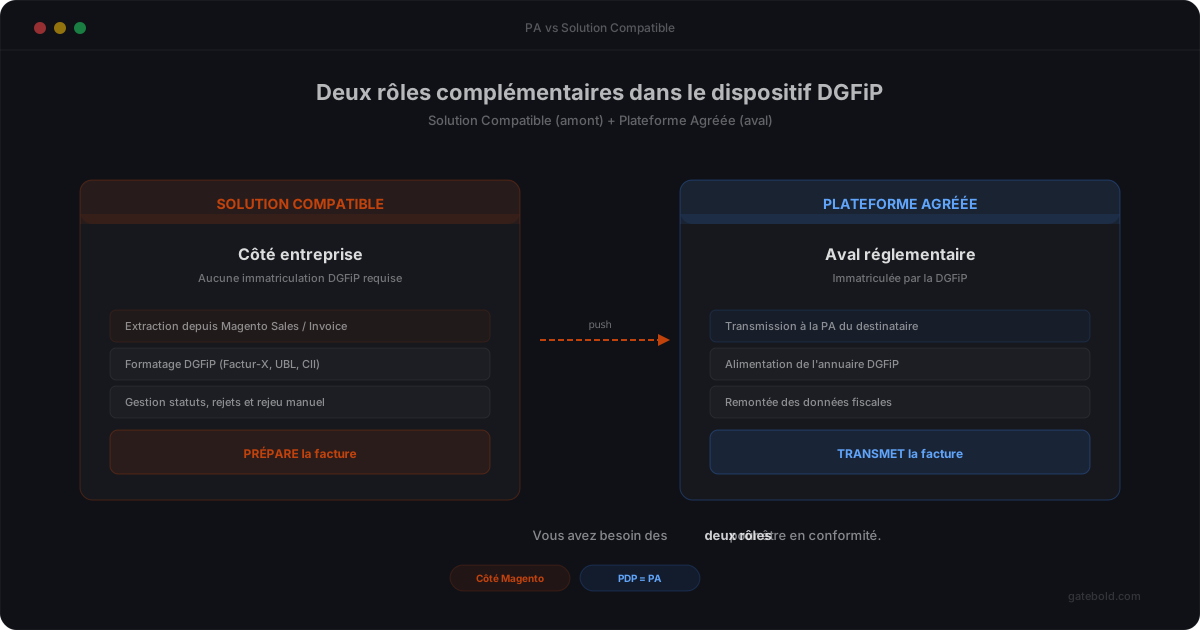
- Approved Platform (Plateforme Agréée, PA) = entity registered with the DGFiP with a regulatory status. It transmits invoices, feeds the central directory and reports tax data to the administration.
- Compatible Solution = company-side component that prepares normalized invoice data (EN 16931 model), validated and traceable, then transmits it to a PA. No registration required, but technical compliance is mandatory. It is the PA that produces the regulatory format.
- The two are complementary: Compatible Solution upstream, Approved Platform downstream. You need both to be compliant.
- For a Magento 2 or Adobe Commerce store that invoices from Sales / Invoice, the Magento connector plays the role of Compatible Solution (Gatebold E-Invoice Gateway), and connects to the PA of your choice.
Why this distinction creates confusion
The French reform introduced two new acronyms into merchants’ vocabulary: PA (Approved Platform) and Compatible Solution. On top of that comes the history of the reform project, which evolved between 2021 and 2024 with several successive models: PPF (Portail Public de Facturation, announced in 2021 as a free invoice-filing platform and refocused in October 2024 on the directory and the data concentrator - it offers no invoice-filing service), PDP (Plateforme de Dematerialisation Partenaire, the historical term still used in the press and online searches), OD (classic dematerialization operator, with no DGFiP status). Many existing providers positioned themselves as “compatible” even before the contours of the PA status were stabilized. For the precise role of the OD next to these two bricks, see PA, OD, Compatible Solution: who does what.
The result: a Magento merchant scoping their project today, with the mandate in force, faces a dozen providers all claiming some form of compliance, without the exact nature of their commitment always being clear. This note clarifies who does what in the official framework.
PDP or Approved Platform: are they the same thing?
Frequent question in 2026 because the term PDP (Plateforme de Dematerialisation Partenaire) is still massively used in the business press and Google searches. Short answer: yes. The Approved Platform (PA) is the current regulatory name for what the initial project called PDP. The DGFiP stabilized the term “Plateforme Agréée” around 2024 to clarify the registration status. When you read “PDP” in an article or a vendor quote, read “Approved Platform”.
A short definition of each
An Approved Platform (PA) is a legal entity registered with the Direction Générale des Finances Publiques under a precise set of requirements. It is authorized to transmit electronic invoices between French companies, to feed the DGFiP central directory, and to report aggregated tax data to the administration. It can be a historical EDI operator, a subsidiary of a software vendor, or a dedicated entity. The PA status is obtained through an application process followed by a technical audit.
A Compatible Solution is a software component or a service that can prepare electronic invoices with data aligned with the EN 16931 semantic model (the mandatory data that will then feed the Factur-X, UBL or CII formats), validate it, and transmit it to an Approved Platform. Producing the regulatory format itself is the PA’s job. A Compatible Solution does not hold the PA status and therefore cannot transmit invoices directly to the administration. It sits upstream, on the company side, as a gateway between the business system (Magento, ERP, etc.) and the PA.
Comparison table
| Criterion | Approved Platform (PA) | Compatible Solution |
|---|---|---|
| DGFiP registration | Yes, mandatory | Not required |
| Position in the flow | Downstream - transmits the invoice to the administration and the recipient | Upstream - prepares the invoice on the company side |
| Regulatory transmission | Authorized | Not allowed |
| Regulatory format | Produces the format (Factur-X, UBL, CII) + structural checks | Normalizes and validates the data (EN 16931 model) |
| Central directory | Feeds the directory | Does not access it directly |
| Multi-PA interoperability | Exchanges with other PAs via the directory | Must be able to adapt to any PA |
| Freely changeable | Yes, you change PAs without changing legal entity | Yes, depends on your business stack |
| Coverage of the 3 obligations of the mandate | Yes by design | Must be designed for all 3 |
The table sums up the logic: your Compatible Solution prepares, your Approved Platform transmits. You need both roles to meet the obligation, otherwise you either cannot produce a compliant invoice (without a Compatible Solution), or cannot transmit it legally (without a PA).
Who produces the invoice, who transmits it?
To fully grasp the chain, here is the journey of a B2B invoice issued from a Magento store, step by step.
- Magento emission. The merchant creates an invoice from Magento Sales / Invoice for a French business customer. Magento stores the invoice in its database with the business data (lines, VAT, legal mentions, customer identifiers, etc.).
- Compatible Solution extraction. The connector retrieves the issued invoice, checks its completeness (buyer SIRET, VAT, etc.), normalizes its data against the EN 16931 model and transmits it to the merchant’s Approved Platform through an API aligned with the AFNOR XP Z12-013 standard.
- Reception and formatting by the issuing PA. The PA receives the data, produces the regulatory format (Factur-X, UBL or CII) and validates it structurally (EN 16931 schema respected, optional signature, etc.). If it is rejected, it sends an error status back to the connector, which surfaces it on the Magento side for manual replay.
- Routing via the directory. The issuing PA queries the DGFiP central directory to identify the recipient’s PA. The directory is kept up to date by the DGFiP with all active SIREN numbers.
- Inter-PA transmission. The issuing PA sends the invoice to the recipient’s PA over an interoperable protocol (PEPPOL or equivalent). The recipient’s PA makes it available to the customer.
- Tax reporting. In parallel, the issuing PA aggregates the tax data (VAT collected, etc.) and reports it to the DGFiP at a defined cadence.
- Status feedback. At each step, statuses are sent back upstream to the Magento connector, which displays them: “transmitted to the PA”, “accepted by recipient”, “rejected for reason X”, etc.
At no point in this chain does your Magento talk directly to the administration. All regulatory interactions go through the Approved Platform, which is your single interface to the DGFiP framework.
Three concrete cases for Magento
Case A: You are starting from scratch, with no ERP and no existing DGFiP connector. You first choose an Approved Platform from the official DGFiP list, based on your price, support and geography criteria. Then you install a Magento Compatible Solution that interfaces with that PA. This is the classic scenario for a pure Magento B2B merchant. The Magento-side connector is a module that installs into your Magento / Adobe Commerce.
Case B: Your accounting ERP already offers a PA connector, and issues your legal invoices. In this case, your Compatible Solution lives in your ERP, not in Magento. The invoice is issued from the ERP, transmitted to the PA, and the Magento-ERP coupling remains internal (Magento order → ERP via your usual integration). You add nothing on the Magento side.
Case C: You invoice from Magento but your Approved Platform provides its own Magento plugin. Check that the plugin covers the 3 obligations of the mandate (e-invoicing, transaction e-reporting, payment e-reporting), rejections and manual replay, and that it adapts to your business rules (multi-store, multi-currency, credit notes, etc.). If so, it is enough. Otherwise, complement it with a dedicated Magento Compatible Solution that handles what the PA plugin does not cover.
Mistakes to avoid
Thinking that one of the two pieces is enough. Having a PA without a Compatible Solution means you will not be able to produce a compliant invoice from Magento. Having a Compatible Solution without a PA means you will not be able to legally transmit your invoices to the administration. You need both, not one or the other.
Choosing a PA locked in by a software vendor. Some vendors push their in-house PA with a proprietary Magento connector and a non-standard storage format. In the short term it is simple. In the medium term it is vendor lock-in that makes any PA change costly. Prefer decoupled architectures where the Compatible Solution and the PA can evolve independently.
Confusing a “Compatible Solution” with a simple Factur-X PDF generator. The role of a Compatible Solution is not to build an output file - it is to guarantee conformant, traceable data all the way to the PA: handle feedback (statuses, rejections), cover the 3 obligations of the mandate, trace flows for tax audits, and allow manual replay. Producing the regulatory format is the PA’s job. A script that adds an XML layer to your PDF is not enough.
Buying the PA before auditing your data. If your Magento invoices already contain all the mandatory data of the EN 16931 norm (buyer SIRET, detailed legal mentions, VAT by rate, etc.), any PA will work. If your data is incomplete, no PA or Compatible Solution will be able to compensate for that gap. Audit your data before signing a contract.
Summary
The Approved Platform and the Compatible Solution are the two complementary components of a Magento merchant’s compliance with the French e-invoicing reform. The PA carries the regulatory role (format production, transmission, directory, tax reporting, etc.). The Compatible Solution carries the business role (extraction from Magento, EN 16931 normalization, validation, status management, etc.). You need both.
For a Magento merchant who invoices from Sales / Invoice, the most solid architecture is to choose a quality PA among the operators registered with the DGFiP, and to interface it through a dedicated Magento Compatible Solution. This separation of roles gives you the freedom to change PAs if needed and ensures your compliance does not depend on a single provider.
Going further
- The complete guide to the 2026-2027 DGFiP reform covers the timeline, the actors and the overall action plan for Magento.
- Choosing between Factur-X, UBL and CII - technical comparison and recommendation for a Magento merchant.
- The 3 obligations of the mandate: e-invoicing and e-reporting - which obligations your Compatible Solution must cover.
- PA, OD, Compatible Solution: who does what - the third role of the framework, the Dematerialization Operator, and its limits.
- Lifecycle of an electronic invoice - 7 steps between Magento emission and final acceptance.
- Magento compliance action plan - 6 phases to prepare your store in 8 to 13 weeks.
To discuss your specific case, the Gatebold E-Invoice Gateway product opens a technical discussion with no commitment.