



Magento and e-invoicing: how to bring your store into compliance
A concrete action plan for a Magento or Adobe Commerce store that must comply with the French e-invoicing reform: diagnostic, scope, budget and the typical timeline of a compliance project.
In this article
Key takeaways
- For a Magento or Adobe Commerce store invoicing in B2B, compliance with the French DGFiP reform rests on 3 pillars: auditing your data, choosing an Approved Platform (Plateforme Agréée), activating a Compatible Solution on the Magento side.
- 8 to 13 weeks for a well-equipped store, more for complex cases (multi-store, custom modules, etc.).
- Start 6 months before your deadline to absorb data adjustments without rushing.
- Keep Magento as you know it: no core rebuild needed in the vast majority of cases, just a well-integrated Compatible Solution connector.
What is at stake for a Magento merchant
If you run a Magento B2B store in France, the question is no longer “do I need to comply?” - the law requires it. The real question is: how do you comply without disrupting your commercial operations and without hidden costs?
The good news is that the French reform allows a decoupled architecture: your Magento remains your commercial source of truth, your Approved Platform handles the regulatory relay, and a Compatible Solution bridges the two. No rebuild, no big-bang switchover, no downtime.
The bad news is that this decoupling does not set itself up. You need to diagnose your situation, choose your providers, configure the connector, test in sandbox, and switch to production. That compliance project is what this article describes, step by step.
Pre-project diagnostic: 5 questions to ask yourself
Before choosing any provider, answer these 5 questions. They determine the complexity of your project and the functional scope to cover.
1. Are your invoices emitted from Magento or from an ERP? If they come out of an accounting ERP (Sage, Cegid, Odoo, etc.), the ERP is what must interface with the PA. Magento plays no direct role in compliance. If they come out of Magento Sales / Invoice, a Magento Compatible Solution is what you need.
2. Does your Magento hold all the mandatory data? Buyer SIRET, intra-community VAT identifiers, per-line legal mentions, VAT breakdown by rate, payment terms, etc. If a field is missing, it will block transmission. A quick upfront audit saves you weeks of debugging in sandbox.
3. How many invoicing profiles do you manage? A single-store, pure French B2B shop is the simplest case. Multi-store setups with distinct legal entities, multi-currency, credit notes, pro forma invoices, recurring subscriptions, etc. add complexity to the connector configuration.
4. What is your monthly B2B invoice volume? It determines your pricing tier for both the PA and the Compatible Solution. Under 100 invoices/month, you are on an entry tier. Above 10,000/month, you are on an enterprise tier with dedicated support.
5. Do you have a parallel Magento evolution project? Migration to Adobe Commerce Cloud, major upgrade, redesign, etc. If so, sequence things properly: compliance work should happen on a stable Magento version, not in the middle of a rebuild.
Action plan in 6 phases
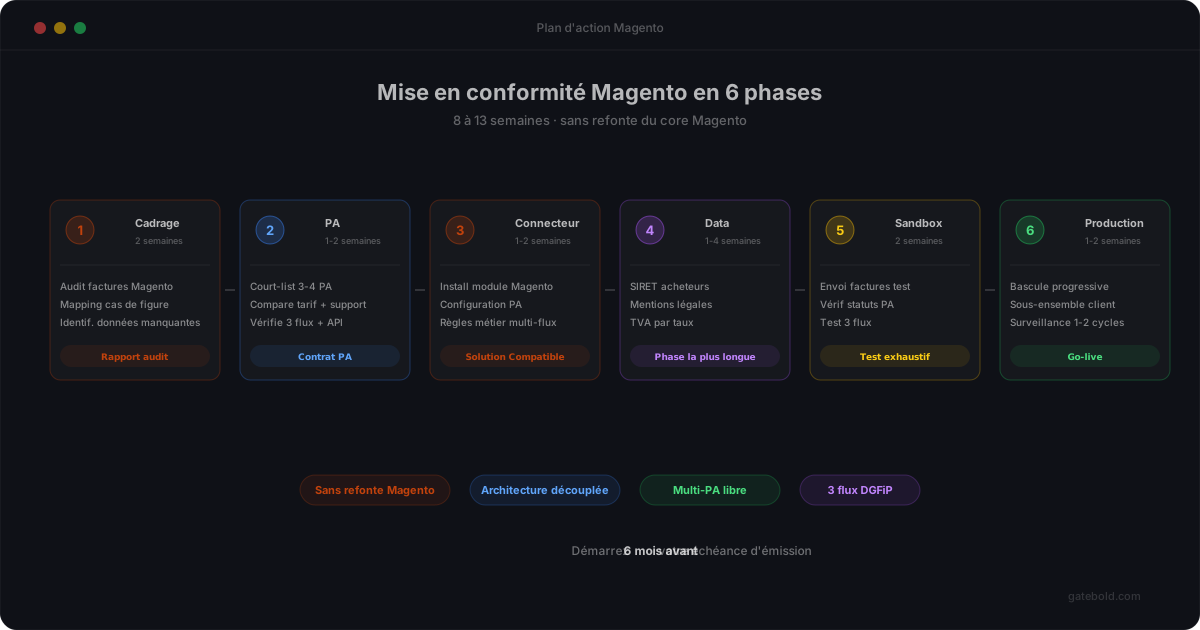
Here is the concrete timeline of a Magento B2B compliance project, from scoping to production.
Phase 1 - Scoping and data audit (2 weeks). Go through the 5 questions above. Audit your existing Magento invoices: extract a representative sample (1 month of production), check the mandatory DGFiP fields, identify missing or inconsistent data. Deliverable: an audit report and a data action plan.
Phase 2 - Approved Platform selection (1 to 2 weeks). Shortlist 3 to 4 candidate PAs from the official DGFiP list. Request quotes, verify the critical criteria (coverage of the 3 flows, support quality, PEPPOL interoperability if relevant, exposed API, etc.). Sign the contract.
Phase 3 - Compatible Solution activation (1 to 2 weeks). Install the Magento connector, configure it with your PA credentials, set up the business rules (EN 16931 normalization, VAT mapping, credit note handling, etc.). The connector must also be wired to the transaction e-reporting and payment e-reporting flows.
Phase 4 - Data correction (variable, 1 to 4 weeks). Update your product catalog, your customer base and your legal mention templates to fix the gaps identified in phase 1. This is often the longest phase because it involves your business teams (sales, accounting, marketing, etc.).
Phase 5 - Sandbox testing (2 weeks). Send a representative volume of invoices to the test environment (French B2B, European B2B, B2C, export, credit notes, etc.). Verify the statuses returned by the PA. Fix the last anomalies. The sandbox must also exercise the e-reporting flows, not just e-invoicing.
Phase 6 - Progressive production rollout (1 to 2 weeks). Go live with a reduced subset (for example the clients who already request electronic invoices). Monitor over 1 to 2 full emission and settlement cycles. Then roll out to your entire customer base.
Total range: 8 to 13 weeks for a standard Magento case with reasonably clean data. For complex cases (multi-store, custom modules, scattered data), allow 15 to 20 weeks.
What you manage vs what Gatebold manages
For a Magento merchant who picks Gatebold E-Invoice Gateway as their Compatible Solution, here is the typical split of responsibilities.
| Responsibility | You (merchant) | Gatebold |
|---|---|---|
| Choice of the Approved Platform | Yes | Comparison guidance |
| Magento data audit | Leads | Audit tooling + recommendations |
| Business data correction | Yes | No |
| Connector installation and configuration | Validation | Leads |
| EN 16931 normalization + validation | No | Yes |
| Push to the PA | No | Yes |
| Sandbox testing | Business validation | Technical execution |
| Status and rejection handling | Business processing of rejections | Status feedback + manual replay |
| Ongoing maintenance (norm, PA, etc.) | No | Yes |
The principle is simple: you remain responsible for your business data (the merchant’s side of things), Gatebold carries the technical integration on the Magento side (extraction, EN 16931 normalization, validation, push to the PA), and the Approved Platform produces the regulatory format and provides the relay to the DGFiP and the recipient’s PA.
Three risks of waiting
Risk 1: vendor and PA overload in summer 2026 and summer 2027. The periods just before the deadlines will be congested for every provider. Starting early guarantees you attention and support. Starting inside the critical window exposes you to longer activation lead times and reduced guidance.
Risk 2: data adjustments taking longer than planned. Nearly every project discovers missing or inconsistent data during the audit phase (SIRET not filled in, incorrect VAT breakdown, outdated legal mentions, etc.). Correction systematically takes longer than expected because it mobilizes business teams outside the technical team. Starting early gives you the necessary margin.
Risk 3: commercial impact at the deadline. If you are not compliant on September 1st of your deadline year, your large accounts will refuse your invoices and block payment. Your B2B tenders will require compliance as a prerequisite from 2026. The commercial loss of a missed deadline far exceeds the cost of a compliance project done on time.
Wrapping up
Bringing Magento into compliance with the French e-invoicing reform is a manageable but non-trivial project. It rests on a decoupled architecture: Magento remains your commercial source, a Compatible Solution does the bridging, an Approved Platform carries the regulatory compliance.
Allow 8 to 13 weeks for a standard case, start 6 months before your deadline, and invest in your upfront data audit. The result is a compliant store with no rebuild, ready for the 2026 or 2027 deadlines depending on your company category.
Discuss your case
Gatebold E-Invoice Gateway is the Magento compatible solution for French e-invoicing, connected to state-registered Approved Platforms, bridging your store and the PA of your choice. Our team can support your project through preparation, connector installation, sandbox testing and production rollout - from preparation all the way to production.
If you want to scope your compliance project, contact us from the E-Invoice Gateway page. A first 30-minute call to frame your case, with no commitment. For the plan details, see our E-Invoice pricing.
Going further:
- The complete guide to the DGFiP 2026-2027 reform for the regulatory context and the timeline.
- Understanding the difference between PA and Compatible Solution to assign roles correctly.
- Choosing between Factur-X, UBL and CII for the technical format decision.
- The 3 DGFiP flows: e-invoicing and e-reporting for the scope your Compatible Solution must cover.
- Lifecycle of an electronic invoice to understand statuses and manual replay.
- EN 16931: the semantic model of the electronic invoice to understand the standard behind data normalization.